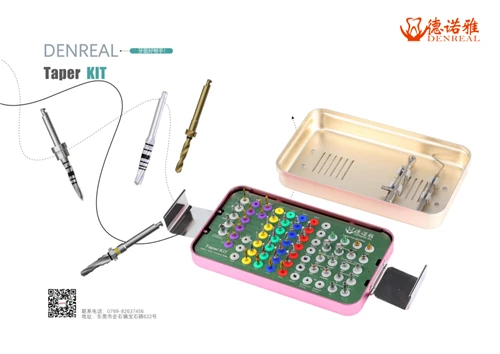
Determining the material of an implant kit primarily relies on its manufacturing material type, surface treatment process, and corresponding biocompatibility and mechanical properties. This is crucial for ensuring surgical safety and long-term stability.
1. Core Material Types
Medical-grade stainless steel (e.g., SUS304, SUS316L): Widely used in routine surgical instruments, it possesses excellent corrosion resistance and strength, suitable for frequent sterilization. SUS316L contains molybdenum, offering stronger resistance to chloride ion corrosion and making it more suitable for complex environments.
Titanium alloy: Some high-end kits are made of titanium alloy, especially suitable for patients with metal allergies. It is lightweight, has excellent biocompatibility, and is non-magnetic, so it does not interfere with imaging examinations.
Special coating on tool heads: For example, drill bits may have titanium nitride (TiN) or diamond coatings, improving wear resistance and cutting efficiency, and reducing intraoperative heat damage to bone tissue.
Material information can be confirmed through the product manual or packaging label. Reputable products will clearly indicate material standards such as "SUS304" or "Ti-6Al-4V".
2. Surface Treatment Characteristics Identification
Passivation Treatment: High-quality instruments have a uniform matte silver surface, free of obvious scratches or rust, effectively reducing the risk of metal ion leaching.
Anodizing/Micro-arc Oxidation: Some aluminum alloy parts (such as handles) exhibit a black or colored film after this treatment, enhancing wear resistance and insulation.
Sandblasting and Acid Etching (SLA): Although mostly used for the implant itself, some high-end kits also employ similar processes for clamping components to improve friction and anti-slip properties.