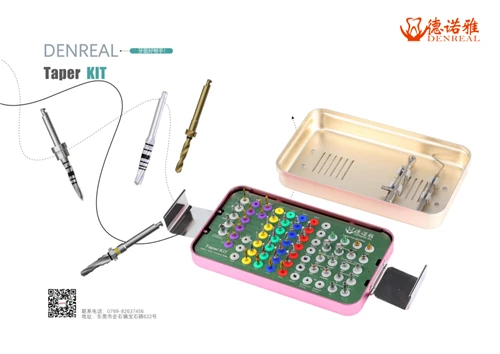
Dental implant kits mainly include intraosseous implants, subperiosteal implants, transmandibular implants, intramucosal implants, and immediate loading implants. Different types of implants are suitable for different oral conditions and restorative needs.
Intraosseous Implants: This is the most common and widely used type of implant. The implant is surgically inserted directly into the jawbone, forming a strong osseointegration with the bone tissue. It is suitable for patients with single, multiple, or complete tooth loss, and has high stability and long-term success rates. Materials are mostly pure titanium or titanium alloys, with good biocompatibility.
Subperiosteal Implants: Suitable for patients with insufficient alveolar bone height but sufficient width. The implant is located below the periosteum, not directly inserted into the bone, but fixed to the jawbone surface by a metal framework. Surgical trauma is smaller, and recovery is faster, but stability is slightly lower than with intraosseous implants.
Transmandibular implants: Primarily used for edentulous patients with severe mandibular atrophy. The implant penetrates the entire mandible, with both ends fixed to the lower border of the mandible and the oral cavity, providing extremely strong support. Although the surgery is complex, it effectively supports full-mouth fixed restorations.
Intramucosal implants: A temporary or transitional type of implant, not implanted into the bone but fixed in the gingival mucosa. Mainly used for patients with poor alveolar bone conditions or requiring short-term restoration. Their stability is relatively poor, and they are usually used as an auxiliary retention method for removable dentures.