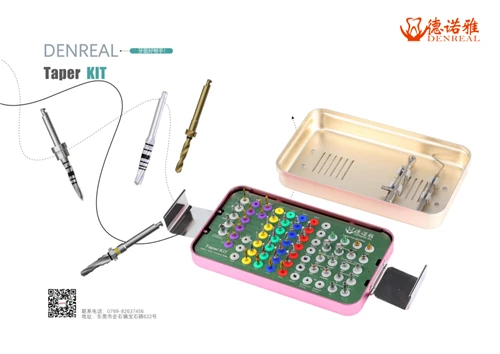
The core advantages of dental implant kits lie in their standardization, high precision, and comprehensive improvement in clinical efficiency, ensuring the safety, stability, and predictability of the surgery.
Standardized Configuration Ensures Surgical Success
A complete dental implant kit adheres to international standards (such as ISO 13485) and includes three main categories of core components, forming a functional closed loop:
Positioning and Guiding Components: Such as guide rods and positioning sleeves, used to accurately determine the implant's insertion angle and depth, avoiding damage to nerves and blood vessels.
Bone Preparation Components: Such as reamers and bone chisels, used to sequentially ream holes to match the implant diameter, protecting bone tissue viability.
Implant Handling Components: Such as torque wrenches, implant forceps, and healing abutment placement devices, ensuring controllable implant insertion force (typically controlled at 30–50 Ncm), achieving initial stability.
These instruments undergo rigorous sterilization and are designed for durability (mostly using SUS304 or higher medical-grade stainless steel), supporting repeated use and reducing the risk of cross-infection.
High-precision compatibility with mainstream implantation systems
Implantation instrument interfaces must be fully compatible with mainstream brands (such as Nobel and Straumann), with taper tolerance controlled within ±0.5° to ensure:
Precise torque transmission, preventing slippage or over-tightening;
Seamless integration of the navigation system and physical tools, improving the success rate of digital implantation;
Clear clinical operation feel, such as the "click" feedback of a torque wrench, enhancing physician confidence.